1. Executive Summary
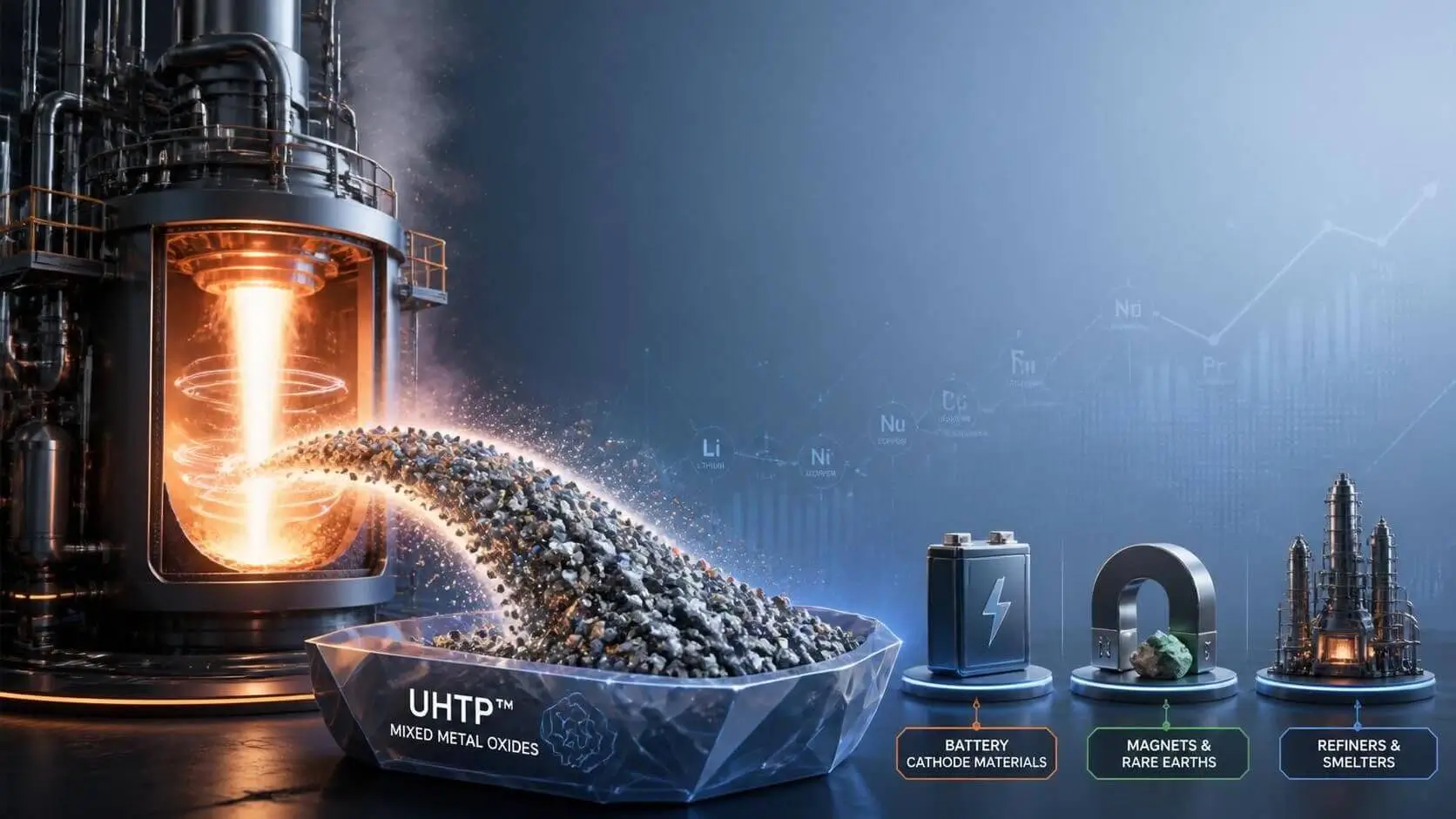
Mixed metal oxides are worth more and sell faster than traditional concentrates when produced from difficult ores, tailings, and e-waste.
Unlike conventional concentrates—which buyers must spend time and money testing, blending, and refining— mixed metal oxides produced by our unique UHTP™ process (Ultra High Temperature Pyrometallurgy™) are a ready-to-buy product. They’re homogeneous, predictable, and have been stripped of impurities such as sulphur and phosphorus, so refiners can jump straight to processing with minimal waste and higher payable yields. This means:
- Higher margins for you: Buyers pay premiums for cleaner, simplified feedstock
- Faster cash flow: Shorter sales cycle; fewer buyer objections
- Lower your liability: No hazardous chemical waste to manage or remediate
UHTP™ turns complex feedstocks into ready‑to‑buy oxide products that command premiums, shorten sales cycles, and reduce environmental liability.
Yes, UHTP™ processing requires upfront equipment investment and energy. But that cost disappears when you eliminate chemical reagents, waste streams, and the price discount buyers demand for “dirty” concentrates. Plus, with today’s soaring prices for critical metals and rare earths, the premium buyers pay for clean mixed metal oxides often exceeds your added processing cost.
Bottom line: You’re not selling a concentrate—you’re selling a finished ingredient refiners are eager to buy.
2. Mixed Metal Oxides: What Buyers Actually Want
Mixed metal oxides are a distinct product category fundamentally different from traditional mineral concentrates. They emerge from UHTP™ processing as homogeneous, chemically stable solids that behave predictably in downstream refining operations.
What makes them valuable:
- Homogeneity across batches: Unlike concentrates (which vary in grade, mineralogy, and impurity profile), mixed metal oxides arrive with consistent composition. Refiners can process them with standardised parameters, cutting trial-and-error and waste.
- Impurities stripped away: UHTP™ volatilises sulphur and phosphorus whilst oxidising metals, creating a product free of the refractory phases that plague traditional concentrates. For hydrometallurgical refineries, this means dramatically lower reagent consumption and faster leaching kinetics.
- Metals liberated from nano-scale entrapment: Complex ores and tailings lock valuable metals in crystal lattices and nanocrystalline phases that conventional processing cannot reach. UHTP™ shatters these structures, liberating metals into oxide form. The result: recovery rates that jump 200–500% versus conventional beneficiation. Study this case study where we [liberated 500% more gold] that traditional analysis detected.
- Ready-to-process format: Buyers don’t need to characterise, blend, or pre-treat the material. It arrives at the refinery as a known entity. That certainty is worth significant money.
- Form factors (powder or pellets) and tailored compositions mean sellers can meet specific buyer needs directly, from battery precursors to REE feeds.
This is not marginal improvement. This is a fundamental shift in how complex feedstocks can be monetised.
3. Why This Matters: Market Pull & Urgency
The global supply of critical metals is under unprecedented strain. Battery makers, electronics manufacturers, and defence industries are competing for constrained supplies of lithium, cobalt, nickel, rare earth elements, and platinum group metals. Simultaneously, primary mining supply chains are stretched, ore grades are declining, and new mine development timelines stretch beyond a decade.
Into this bottleneck comes a brutal reality for refiners: they cannot afford complex, unpredictable feedstock anymore.
Traditional concentrates demand buyer investment:
- Extensive testwork to understand behaviour in their specific circuits
- Metallurgical adjustments to handle variable impurity profiles
- Waste management and environmental remediation costs
- Tied-up capital in inventory whilst characterisation occurs
Mixed metal oxides eliminate all of this. Refiners can immediately slot them into existing processing infrastructure. No additional testing. No workflow redesign. No chemical adjustment. The refiner’s job becomes simpler, faster, and more profitable.
By supplying standardised oxide products, sellers bypass these barriers and access a broader set of buyers willing to pay for certainty.
This is why demand is accelerating. Refiners are actively seeking suppliers who can deliver mixed metal oxides. Umicore, Glencore, BASF, Lynas, and other major offtakers have publicly stated their preference for clean, homogeneous feedstocks. Battery material manufacturers are building entire production lines predicated on oxide-based feeds. And they’re willing to pay premiums for certainty.
For feedstock owners—mine operators, recyclers, tailings processors—this represents a historic opportunity. The market is reshaping itself around clean, predictable supply. The question is no longer whether mixed metal oxides matter. It’s how fast can you scale them.
4. Value Propositions: Why Refiners Pay More
Mixed metal oxides command higher prices for distinct economic reasons.
Lower Processing Cost for the Refiner
Hydrometallurgical refining—the dominant pathway for critical metals—relies on chemical leaching circuits. Traditional concentrates introduce variability that forces refiners to overfeed leaching agents, run extended residence times, and manage complex waste streams. Mixed metal oxides, by contrast, leach cleanly and completely. Refiner economics improve by 30–40% on chemical consumption alone. That saving converts directly into higher offers or tolling arrangements for oxide suppliers.
Higher Payable Metal Recovery
Concentrates are dirty products. They contain locked-in value in refractory phases that conventional hydrometallurgy cannot access. Refiners expect 10–20% metallurgical losses as standard. Mixed metal oxides, already stripped of refractory architecture, convert at 95%+ efficiency. Refiners capture value that was previously lost. They pass a portion of this gain back to you as a price premium—typically 15–30% above concentrate pricing for equivalent metal content. In practice this means faster monetisation of tailings, e‑waste or low‑grade ore streams that previously had little saleable value.
Certainty & Reduced Risk
Buyer risk premiums are real. Refiners require extended testwork before committing to unfamiliar concentrate sources. This delays purchase decisions and ties up working capital. Mixed metal oxides, already proven and homogeneous, reduce buyer risk to near zero. They purchase faster, negotiate simpler contracts, and allocate less technical scrutiny. For you, this means faster cash conversion and stronger negotiating power.
Supply Chain Security for Buyers
As supply chains fragment globally, refiners prize suppliers who deliver consistency and volume stability. Mixed metal oxides—as a standardised product—make your supply chain more valuable to them. A refiner running a battery precursor facility will contract preferentially with a producer who guarantees homogeneous oxide supply over one offering variable concentrates.
5. Who’s Buying—And Why
Hydrometallurgical Refiners
Companies like Umicore, Glencore, and regional refiners globally process concentrates into refined metals or intermediate products. They favour mixed metal oxides because oxide chemistry cuts their chemical costs, reduces environmental liability, and shortens production cycles. These are margin-driven buyers paying premiums for operational simplicity.
Battery Material Manufacturers
BASF, Benchmark Metals, and EV battery makers increasingly build production lines predicated on oxide feedstocks rather than concentrates. Oxide chemistry integrates directly into their precursor manufacturing without intermediate processing. For them, mixed metal oxides are no longer a preference—they’re becoming a requirement.
Rare Earth & Specialty Metal Refiners
Lynas Rare Earths, MP Materials, and other rare earth processors utilise oxides as intermediate products. Mixed metal oxides from UHTP™ processing arrive already in the form they need, eliminating expensive roasting and chemical conversion steps. The margin advantage is substantial.
Precious Metal Processors
For gold, platinum, and PGM-bearing feedstocks, mixed metal oxides enable gravity separation and fire assay processing with minimal slag management. Processing costs drop, and recovery rates increase. Premium buyers in this space actively seek oxide suppliers.
E-Waste & Recycling Operators
Critical metal recovery from e-waste, spent catalysts, and battery recycling requires beneficiation of complex, mixed-metal streams. Traditional flotation and gravity separation are inefficient on these materials. UHTP™ processing converts them into mixed metal oxides that refineries can process directly, unlocking value that recycling has struggled to capture.
Trading houses and tolling partners also favour oxide supply because it reduces technical negotiation and enables quicker contract turnarounds.
Across all these buyers, the message is consistent: homogeneous, predictable, clean oxide feedstock sells faster and commands premiums. That’s your market.
6. Commercial Product Options
UHTP™ processing enables flexibility in product specification, with particular advantage for high-value metal streams where conventional beneficiation struggles and refiners command strong margins.
Precious Metal Oxides — gold, silver and PGM oxides recovered from complex ores, secondary feedstocks and spent catalysts — offer clear commercial upside: UHTP™ liberation increases recoveries from typical 60–75% to 90%+, producing fire‑assay‑ready oxide material that eliminates intermediate roasting and costly chloride leaching. Refiners pay premiums for PGM‑rich oxide feeds (platinum, palladium) sourced from primary ores, recycled catalytic converters and industrial spent catalysts; constrained PGM supply further supports price, and oxide products enable direct refining routes that make feedstock economics highly attractive.
Rare Earth Element (REE) Oxides — Separated rare earth oxide concentrates (lanthanum, cerium, neodymium, dysprosium, terbium). REE markets are supply-constrained and geopolitically fragmented. Buyers like Lynas Rare Earths, MP Materials, and Asian refiners require homogeneous oxide feedstock to feed rare earth separation circuits. UHTP™ processing of REE-bearing ores and tailings produces oxides with <0.5% impurity that feed directly into solvent extraction lines. REE oxide pricing reflects both metal content and supply scarcity—typically 2–3x the price-per-tonne of base metal oxides.
Cobalt Oxide Concentrates — Cobalt-rich mixed oxides from primary cobalt ores, copper-cobalt tailings, and e-waste. Battery makers and superalloy manufacturers bid aggressively for clean cobalt oxide. With cobalt prices volatile and supply concentrated in Central Africa, refined buyers contract for oxide feedstock to secure supply and manage cost volatility. Cobalt oxide commands 20–40% premiums over traditional cobalt concentrates.
Lithium & Battery Metal Oxides — Lithium, nickel, cobalt, and manganese oxides optimised for battery precursor manufacturing. As EV demand scales, battery material makers (BASF, Umicore, Benchmark) increasingly specify mixed oxide blends matching their precursor chemistry exactly. UHTP™ enables precise ratios—e.g., 40% Ni / 20% Co / 10% Mn oxide blends—that feed directly into material synthesis without intermediate processing. These products command the highest margins in the oxide market because they’re tailored to buyer specification.
The Value Hierarchy: Precious metal and rare earth oxides dominate margin economics. Precious metal (PGM) oxides and heavy REE‑rich oxides sit at the top, followed by lithium battery‑grade oxide blends; base‑metal oxides (copper, nickel) sit lower. For owners of complex feedstocks containing precious metals, rare earths, or battery metals, UHTP™ processing unlocks dramatically higher value than traditional beneficiation.
7. From Concept to Certainty DETECT™ and RECOVER™
Mixed metal oxides have clear market value—but whether your material unlocks that value depends on composition, mineralogy, and processing behaviour. We help you prove it through three progressive steps, each reducing risk and increasing confidence. Equally, these steps help us determine whether we want to be your partner on this feedstock.
DETECT™ (4–6 weeks) — Laboratory characterisation. We analyse your feedstock (SEM, XRD, elemental mapping) to understand what you have and predict how UHTP™ will respond. Low cost, fast Go/No-Go assessment. Most operators use this to decide: is RECOVER™ worth the investment? We use it to assess viability.
RECOVER™ (12–16 weeks) — Pilot-scale proof of concept. We process 500 grams through UHTP™, validating recovery rates, homogeneity, and purity. You receive commercial-grade product specifications and buyer-ready samples. By now, most technical risk is eliminated. This data feeds your commercial partnership discussions with us.
Commercial Pilot — Partnership-backed scale-up. Once we’ve agreed to partner, we process 2–5 tonnes at full commercial UHTP™ scale, funded by the partnership. You validate assumptions at production scale, confirm buyer acceptance, and generate the operational data needed to design the commercial plant.
8. How Buyers Validate & Use the Product
Once you’ve produced mixed metal oxides, buyers validate them through standardised testwork:
Chemical Analysis — Inductively coupled plasma mass spectrometry (ICP-MS) or X-ray fluorescence (XRF) confirms metal content and impurity profile. For homogeneous products, a single analysis suffices; for concentrates, multiple samples are required.
Leaching Trials — Small-scale processing in the buyer’s preferred circuit (hydrometallurgical, pyrometallurgical, or direct smelting) validates behaviour. Oxide products leach completely within standard timescales; concentrates often require extended residence times or additives.
Impurity Assessment — Sulphur, phosphorus, arsenic, and other penalty elements are quantified. Mixed metal oxides, already stripped of these, pass with flying colours. Concentrates typically require further processing.
Homogeneity Confirmation — Multiple samples from different production batches are tested to confirm consistency. Buyers use this to set process parameters. Mixed metal oxides allow standardised parameters across all incoming batches; concentrates require batch-by-batch adjustment.
Once validated, buyers typically move to offtake agreements within weeks. This speed—from first sample to signed contract—is the competitive advantage of oxide products versus concentrates.
9. Example Scenario
A mineral processing company operating a tailings storage facility in USA held 50,000 tonnes of mixed mineral tailings rich in rare earths but considered uneconomic under traditional beneficiation. Their attempts to crack the tight crystalline structure were yielding no more than 20% recoveries at best.
DETECT™ (weeks 1–6): We characterised the tailings, confirmed element liberation potential, and projected 90% combined recovery as mixed oxide. The owner decided to proceed.
RECOVER™ (weeks 7–22): Processing multiple tests through our pilot UHTP™ validated our projections. The resulting oxide was homogeneous, assayed at more than 90% rare earth oxide whilst stripping out sulphur, phosphorus , thorium and uranium. The owner further tested the mixed metal oxide and confirmed our results. The owner went on to create a NI-43101 on their asset for their fund raising activities.
Commercial Outcome: The owner monetised 50,000 tonnes of tailings previously considered waste. Capital investment was staged: DETECT™ cost minimal, RECOVER™ cost modest. Total de-risking occurred before committing to commercial plant investment.
10. Conclusions: The Future of Critical Metal Supply
Mixed metal oxides represent a paradigm shift in how complex feedstocks are monetised.
Where traditional concentrates demand buyer investment in complex testing, chemistry management, and waste handling—mixed metal oxides arrive ready to process. This matters because the global supply of critical metals is strained, refinery margins are tightening, and buyers are actively seeking suppliers who can deliver certainty and purity.
UHTP™ technology enables this transition. Your partnership with IPRI puts you at the centre of a market that’s reshaping itself around clean, predictable feedstock.
The competitive advantage is clear:
- Faster sales cycles (weeks, not months)
- Higher prices (15–30% premium over concentrates and closer to full metal prices)
- Stronger buyer relationships (certainty breeds loyalty)
- Lower environmental liability (no chemical waste)
- Monetisation of previously worthless tailings and e-waste
Refiners aren’t adopting mixed metal oxides because they’re trendy. They’re adopting them because they’re economically superior. Battery makers, precious metal processors, and rare earth refiners are building entire production lines around oxide feedstock. Supply contracts are shifting in favour of oxide producers.
The question is no longer whether mixed metal oxides matter. It’s how fast can you scale them.
If you’re sitting on complex ore, tailings, or secondary feedstock, the pathway is clear: DETECT™ → RECOVER™ → Commercial Partnership. Each step reduces risk. Each step proves value. And by the end, you’re selling a product refiners actively compete for.
The future of critical metal supply runs through mixed metal oxides. The opportunity to be part of that future starts now.
11. Contact
Have feedstock or samples? Want hard data, pilot results, or a commercial proposal? Contact us today to request test results, energy & cost metrics, buyer-grade product specs, or to arrange a pilot—let’s turn your material into revenue.
Examples of Buyers
- Sumitomo Metal Mining / Sumitomo Corporation — https://www.smm.co.jp/en/ and https://www.sumitomocorp.com/en/jp
- Mitsubishi Corporation / Mitsubishi Materials — https://www.mitsubishicorp.com/jp/en/ and https://www.mmc.co.jp/eng/
- Umicore — https://www.umicore.com/en
- Glencore — https://www.glencore.com
- BASF — https://www.basf.com
- Lynas Rare Earths — https://www.lynas.com
- MP Materials — https://mpmaterials.com
- Major EV battery / cathode manufacturers (examples) — CATL: https://www.catl.com/en/, LG Energy Solution: https://www.lgensol.com, SK On: https://www.sk-on.com/en/
- Precious‑metal refiners / PGM processors (examples) — Anglo American: https://www.angloamerican.com, Johnson Matthey: https://www.jm.com
- Global trading houses / commodity offtakers (examples) — Trafigura: https://www.trafigura.com, Mercuria: https://www.mercuria.com
Final Considerations
- Definition: consolidated mixed metal oxides (powder or pellets); composition depends on feedstock.
- Product forms: powder for leach circuits; pellets for bulk handling and low‑dust shipping.
- Key benefits: predictable oxide chemistry, improved payable yields, lower reagent/waste costs, faster buyer decisions.
- Commercial SKUs: standard oxide concentrate, battery‑grade blend, REE‑enriched fraction; consider tolling options.
- Pricing & contracts: weight or payable‑metal basis, assay guarantees, moisture allowances, penalty/clawback clauses.
- QA & testwork: concise assay pack (assay, moisture, particle size, recommended use) plus representative leach data.
- Buyers: match form + assay guarantees to buyer type (hydromet, smelters, cathode makers, REE refiners, traders).
- Logistics: dry storage, sealed packaging, clear MSDS/UN classification; highlight low‑dust pellet SKUs.
- Environmental & regulatory: off‑gas control, product stewardship docs, proof of low mercury/cyanide/radioactivity where relevant.
- Commercial risks: heterogeneity, over‑promised recoveries, regulatory delays — mitigate with sampling, pilot lots, independent assays, early regulator engagement.
References
- Fauchais, P.; et al. — Overview of thermal‑plasma arc systems for waste treatment and material processing. Explains reactor types, energy coupling, volatilisation mechanisms and case studies relevant to metal recovery from refractory matrices. Useful for understanding UHTP™ thermal fundamentals and scale‑up constraints.
- “Plasma technology in metallurgical processing” — technical review covering thermal plasma uses in smelting, vaporisation, and synthetic oxide production; discusses energy efficiency and product handling considerations. Good for comparing thermal vs conventional smelting.
- Reviews on oxide thermodynamics and volatilisation (textbook and review papers) — covers Gibbs energy of oxide formation, phase diagrams for multi‑component oxide systems, evaporation coefficients and implications for selective volatilisation/concentration of metals. Essential for predicting which metals concentrate or volatilise during UHTP™.
- Reviews on metal recovery from tailings and e‑waste — surveys mechanical liberation, thermal pre‑treatment, and downstream chemical/electrochemical recovery pathways; includes examples of enhanced recovery from nanometal and encapsulated phases. Useful for economic case studies and feedstock typologies.
- Papers on gold (including nanogold) liberation and recovery — experimental studies comparing thermal disruption vs hydrometallurgical liberation of fine/encapsulated gold.
- “Membrane technologies for critical metal separation” — review of polymeric and inorganic membranes, supported liquid membranes, electrodialysis and electrochemical separation for cobalt, nickel and rare earths; discusses selectivity, fouling, and integration with upstream concentrates (e.g., oxide feeds). Relevant to PertraX™-style separation concepts.
- Reviews on solvent extraction and ion‑exchange for REE and base/precious metals — background for comparing membrane routes to established hydrometallurgical methods.
- Comparative reviews and case studies — life‑cycle and techno‑economic comparisons between chemical‑intensive hydrometallurgy and high‑temperature/thermal approaches; includes energy, reagent use, residue mass, and typical recovery yields for various feedstocks.
- LCA studies comparing chemical and thermal routes for metal extraction and recycling — greenhouse‑gas profiles, emissions from slag/residue handling, and scenarios where chemical‑free claims reduce environmental impact. Useful for substantiating “green” claims and regulatory reporting.
- USGS Mineral Commodity Summaries and industry market reports (2023–2025) — authoritative data on supply/demand, prices, and recycling rates for cobalt, nickel, copper, rare earths and gold. Use for project economic sensitivity and marketability of produced concentrates.
Technical Glossary
Assay / Assaying — Laboratory analysis of ore or mineral samples to determine the concentration and composition of valuable metals. Common assay methods include fire assay (for precious metals), ICP-MS, and XRF. Assaying provides the data required to calculate recovery rates and payable metal content.
Battery Precursor — An intermediate chemical compound from which battery cathode materials are synthesised. Nickel-cobalt-manganese oxides are common battery precursors for lithium-ion batteries. Manufacturers prefer oxide feedstock because it reduces synthesis steps and improves material consistency.
Beneficiation — The process of concentrating valuable minerals and removing waste rock or gangue. Traditional beneficiation uses flotation, gravity separation, or magnetic separation. UHTP™ is an alternative beneficiation method that employs thermal processing.
Cathode Material — The positive electrode in a battery. EV and energy storage batteries require refined cathode materials (typically layered metal oxides). Battery makers source these from refined metal oxides or precursor synthesis operations.
Chloride Leaching — A hydrometallurgical process using chlorine-based chemistry to dissolve metals from ore or concentrate. Common in PGM refining. Environmentally intensive and capital-expensive; UHTP™ oxide products can bypass this step entirely.
Cobalt — A transition metal valued for battery cathodes, superalloys, and catalysts. Cobalt supply is geopolitically concentrated (majority from Central Africa). Cobalt oxide is a strategic high-value product.
Concentrating Circuit — A refinery or processing operation designed to increase metal content and remove impurities. Mixed metal oxides feed directly into concentrating circuits with minimal additional processing.
DETECT™ — IPRI’s laboratory characterisation service. Uses advanced analytical tools (SEM, XRD, elemental mapping etc) to assess feedstock composition and predict UHTP™ processing behaviour. Delivers Go/No-Go assessment within 4–6 weeks.
Downstream Refining — The final processing stages where ore or intermediate products are converted into refined metals or products ready for market. Mixed metal oxides simplify downstream refining by arriving homogeneous and impurity-free.
E-Waste (Electronic Waste) — Discarded electronic equipment including computers, mobile phones, and spent catalytic converters. E-waste contains valuable concentrations of precious metals, rare earths, and battery metals. UHTP™ processing converts e-waste into marketable mixed metal oxides.
Fire Assay — A traditional precious metal refining method using heat and chemical flux to separate gold, silver, and PGM from ore. UHTP™ oxide products are fire assay-ready, eliminating preliminary roasting costs.
Flotation — A mineral separation technique using hydrophobic surfactants to selectively float valuable minerals. Effective for some ores but struggles with refractory minerals and fine-grained phases. UHTP™ complements flotation by processing flotation tailings.
Gangue — Worthless rock and minerals found alongside valuable metals in ore. Beneficiation aims to concentrate valuable metals whilst discarding gangue. UHTP™ oxidises valuable metals and volatilises gangue components (sulphur, phosphorus).
Gravity Separation — A mineral concentration method relying on density differences between minerals. Effective for coarse particles and precious metals but limited for fine-grained complex ores. UHTP™ liberation improves gravity separation efficiency.
Homogeneity — Uniformity of composition across batches. Mixed metal oxides are homogeneous products; traditional concentrates vary batch-to-batch. Homogeneity allows refiners to standardise processing parameters and reduce trial-and-error.
Hydrometallurgical / Hydrometallurgy — Refining metals using liquid-phase chemical processes (leaching, precipitation, solvent extraction). The dominant refining pathway for base metals, rare earths, and battery metals. Mixed metal oxides integrate seamlessly into hydrometallurgical circuits.
ICP-MS (Inductively Coupled Plasma Mass Spectrometry) — An analytical technique for measuring elemental composition with high precision. Standard method for validating metal content in mixed metal oxides.
Impurity Profile — The suite of unwanted elements (sulphur, phosphorus, arsenic, iron, silica) present in ore or concentrate. Traditional concentrates have variable impurity profiles requiring buyer adjustment. Mixed metal oxides arrive with low, predictable impurity profiles.
Leaching — A hydrometallurgical process in which soluble metals are extracted from ore or concentrate using chemical solvents (typically dilute sulphuric or hydrochloric acid). Homogeneous mixed metal oxides leach completely; refractory concentrates require extended residence times and higher chemical consumption.
Liberation — The physical separation of valuable minerals from gangue at the particle scale. UHTP™ processing achieves exceptional liberation of metals from complex mineral assemblages, including nanocrystalline phases conventional methods cannot reach.
Lithium — A light metal essential for battery anodes and electrolytes. Lithium supply is geopolitically constrained. Lithium oxide is a high-value product.
Manganese — A transition metal used in steel, batteries, and catalysts. Often found in association with nickel and cobalt in battery metal streams.
Mixed Metal Oxide — A solid oxide product containing multiple valuable metals in homogeneous, chemically stable form. The primary output of UHTP™ processing. Unlike concentrates, mixed metal oxides are ready-to-process and command premium pricing.
Neodymium — A rare earth element essential for permanent magnets used in wind turbines and EV motors. Neodymium oxide is a high-value strategic product.
OPEX (Operating Expenditure) — Day-to-day costs of running a refinery or processing operation (labour, energy, reagents, maintenance). Mixed metal oxides reduce buyer OPEX by 30–40% through simplified processing.
Ore — Rock containing valuable minerals in economic concentrations. Complex ores with mixed valuable metals are ideal UHTP™ feedstocks.
Oxide / Metal Oxide — A chemical compound of a metal bonded with oxygen. Metal oxides are stable, predictable solids that refine more efficiently than sulfide or silicate minerals.
PGM (Platinum Group Metals) — Precious metals including platinum, palladium, iridium, and rhodium. PGM supply is critically constrained; PGM oxides command the highest margins in the metal oxide market.
Phosphorus — An unwanted element in many feedstocks. UHTP™ volatilises phosphorus during processing, eliminating it from the final product.
Pyrometallurgical / Pyrometallurgy — Metal refining using high-temperature thermal processes (smelting, roasting). UHTP™ is a pyrometallurgical technology. Some mixed metal oxide streams feed directly into pyrometallurgical circuits (e.g., precious metal smelting).
RECOVER™ — IPRI’s pilot-scale validation service. Processes 500 grams of feedstock through UHTP™ reactors, validating recovery rates, homogeneity, and purity. Delivers commercial product specifications and buyer-ready samples within 12–16 weeks.
Refractory Phase — Minerals or crystal structures that resist conventional processing methods. UHTP™ specifically targets refractory phases, liberating locked-in metal value.
Rare Earth Element (REE) — A group of 17 elements (lanthanum, cerium, neodymium, dysprosium, terbium, and others) essential for permanent magnets, phosphors, and catalysts. REE supply is geopolitically concentrated and supply-constrained. REE oxides are high-value products commanding 2–3x the price of base metal oxides.
Roasting — A pyrometallurgical pretreatment step heating ore to decompose minerals and oxidise metals. Traditionally used before hydrometallurgical processing. UHTP™ oxide products often bypass roasting, saving capital and operating costs for refiners.
SEM (Scanning Electron Microscopy) — An analytical technique using electron beams to visualise mineral structure and liberation at the microscale. Essential for DETECT™ characterisation.
Smelting — A pyrometallurgical process using heat and chemical flux to separate metals from ore. Precious metal smelting uses fire assay methods. UHTP™ oxide products feed directly into smelting circuits.
Solvent Extraction — A hydrometallurgical process selectively separating metals using organic solvents. Standard method in rare earth refining. Homogeneous rare earth oxides feed directly into solvent extraction lines.
Sulphur — An unwanted element in ore that causes environmental and processing problems. UHTP™ volatilises sulphur during processing, eliminating it from the final product.
Tailings — The waste stream left after mineral extraction and concentration. Tailings often contain substantial residual valuable metals in refractory forms. UHTP™ processing of tailings recovers previously lost value.
UHTP™ (Ultra High Temperature Pyrometallurgy™) — IPRI’s proprietary thermal processing technology using extreme temperatures to volatilise impurities (sulphur, phosphorus) and liberate metals from complex minerals and refractory phases. The enabling technology for converting complex feedstocks into mixed metal oxides.
XRD (X-ray Diffraction) — An analytical technique identifying mineral phases and crystal structures. Essential for DETECT™ feedstock characterisation.
XRF (X-ray Fluorescence) — A non-destructive elemental analysis technique measuring metal content. Standard method for validating metal content in mixed metal oxides.
Table of Contents
2. Mixed Metal Oxides: What Buyers Actually Want
3. Why This Matters: Market Pull & Urgency
4. Value Propositions: Why Refiners Pay More
7. From Concept to Certainty DETECT™ and RECOVER™
8. How Buyers Validate & Use the Product
Leave a Reply